
Forty-Three Tools, Sixteen Mentions: What the Guides Actually Cover
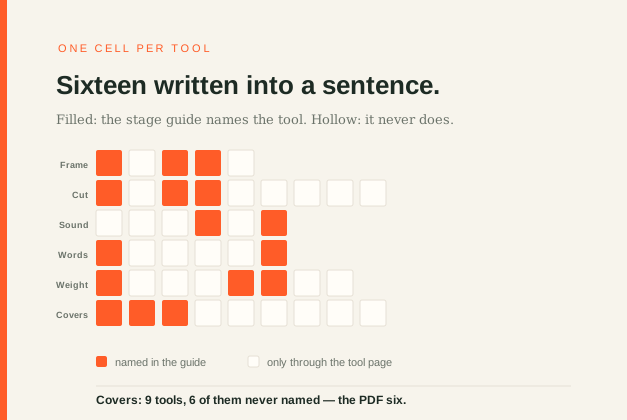
I counted every place a stage guide names one of the 43 tools in its body text. Sixteen tools are written into a sentence. Twenty-seven are not mentioned once. That is not an oversight, it is what happens when guides answer questions instead of describing products, and it has a cost worth seeing.

1. How I counted
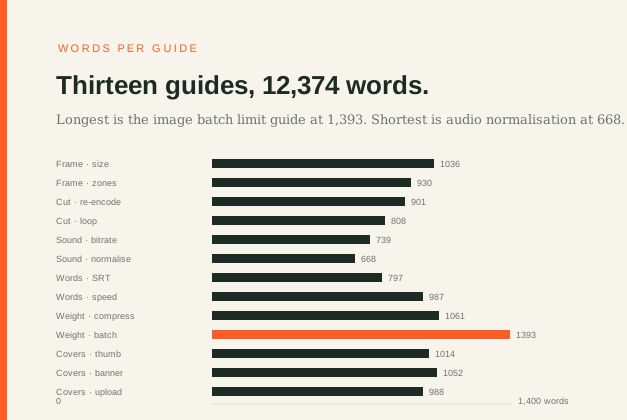
The sample is the thirteen guides the Creator Resources hub lists under its six stages, read in their English versions: 12,374 words of body text in total. A tool counts as named when its exact product name appears in the article body. Names in the related-tools block, the header, the footer or the tool's own page do not count, because those are navigation rather than explanation.
The result was 16 of 43. Every stage has a gap, and no stage has a full set.
2. Six stages, one table
Each stage carries between five and nine tools and between two and three guides. The column that matters is the difference between the second and the third.
| Stage | Tools | Guides | Named | Never named |
|---|---|---|---|---|
| Frame and spec | 5 | 2 | 3 | 2 |
| Cut and join | 9 | 2 | 3 | 6 |
| Sound | 6 | 2 | 2 | 4 |
| Words on screen | 6 | 2 | 2 | 4 |
| Weight and format | 8 | 2 | 3 | 5 |
| Covers and delivery | 9 | 3 | 3 | 6 |
3. Why the guides skip the tool name
A guide that explains a number has to spend its words on the number: where 1544 by 423 comes from, why a second re-encode costs more than the first, why 8192 pixels is a ceiling in this browser. Naming the tool inside that paragraph adds a sentence that teaches nothing about the number.
So the guides were written as answers to questions, and the tools were left to the related block. Two consequences follow, and they are both real: a reader who arrives from search learns the rule but not the instrument, and a tool whose guide never mentions it can only be found from the tool side.
4. Where the gap hurts most
Covers is the widest stage: nine tools, three guides, and six tools that never appear in a sentence. Five of those six are the PDF set: merge, split, rotate, page numbers, and image to PDF. A reader looking for "combine two PDFs" will not find it by reading the banner and thumbnail guides, because those guides are about image specifications, not about assembling documents.
Cut is the next widest gap: nine tools, three named. The six that never appear are the ones that act on the whole clip rather than on a specific number: merger, rotate, flip, speed, loop, and the workspace. Each of them is easy to describe in one line, which is precisely why none of them needed a paragraph in a guide about re-encode cost.
Sound and Words tie at two named tools each. Their guides are about rates and reading speed, and both stop before the workflow questions a creator actually asks: how to join two recordings, how to merge two subtitle files that overlap.
5. What 12,374 words buys
The thirteen guides run from 668 to 1,393 words, and the longest is not the most technical one. The image batch limit guide is the longest because it carries six measured runs, five numbers per run, and a behaviour that needed explaining twice.
Length tracks measurement, not topic size. A guide with one official figure stays near 700 words; a guide with six measurements passes 1,300. That is a useful signal when deciding whether a new topic needs a guide at all: if there is nothing to measure, there is probably nothing to explain.
6. How to read this map
If you are looking for a specific number, start from the guide: the stage pages are sorted by the question they answer. If you are looking for an action, such as merging, rotating or converting, start from the tool page, because that is where those live. The 215 links added to the tool pages exist exactly for this second route.
On the maintenance side, the gap column is a to-do list with a natural order. The PDF six in Covers are the clearest candidate for a single guide, since they share one workflow and one set of page-level decisions.
7. Questions
Does a tool have to be named in a guide to be useful?
No. The related block and the tool page carry it. What a name in the body buys is discovery from search: a reader who lands on the guide can reach the tool without switching path.
Were the guides written to hide the tools?
No, and the length data argues against it. The guides were written around numbers because numbers are what readers arrive with. The tool names were treated as navigation, which is a defensible choice with a measurable cost.
What would change this count fastest?
One guide for the PDF set. Six of the twenty-seven unnamed tools sit in a single stage and share one workflow, so a single piece would move the count from sixteen to twenty-two.